Hello Readers!
I feel helpful today so I'm writing this glossary in case you are having a hard time reading this project. If you are stuck with some words, look for it in this post to check out their definitions! This would help you understand the slavery after the Civil War better. I hope this helps!
Civil War: (Noun) A fight between the same country
I inserted this word in the glossary because it was one of the words that came up the most. Also, I didn't know what it meant before this project. I thought it was a name for a certain war that happened in United States. This is an important word since it is the main word for my topic.
former slaves: (Noun) people who are not slaves anymore
Former slave is one of the words in my glossary because I realized that I didn't know the specific meaning of it and I was using it in the few posts. If I didn't know it, I thought some other people wouldn't know it too. This word is important since it is what the slaves after the Civil War were called.
freedom: (Noun) state of being free: no control over
I know that most people would know what freedom meant, but I just wanted to tell the meaning of it since this word came up a lot in this blog and there might be at least one or two people still not knowing what this means. This word influenced the slaves.
Import: (Verb) to bring something into a country from abroad.
I included this word into my glossary because I didn't know this word before. I wanted the readers to know what it means too, in case they don't know already. This was the way the Americans got the slaves.
reconstruction: (Noun) time period when the U.S rebuilt the union after the Civil War
Reconstruction was one of the words that I knew, but not the one from the history in United States, so I decided to put it in the glossary. This period of time is the main setting in this blog.
sharecropper: (Noun) farmer who shares the crop with the land's owner
Sharecropper was one of the topics I used for a genre. I thought it would be helpful to give the simplest definition I can so here it is.
slaves: (Noun, plural) people who is a property of someone who has someone to control over them
Most people would know what slaves mean. But I thought it would be important to write the definition of it since this blog is all about the slaves. The purpose of reading this blog would be gone. Also, as I was looking through the blog to revise, I noticed that there wasn't a single definition of slaves so I decided that this place would be the best for this word.
Tuesday, May 27, 2008

Monday, May 26, 2008
Bibliography (revised):
Print sources:
"The Irrepressible conflict." The World Book of Encyclopedia. 1980
.
"The Road to War." World History. 2006.
Primary sources:
"13th Amendment." US Constitution.
<http://virtualology.com/hallofthehistoricarchives/13THAMENDMENT.COM>
Website sources:
Cozzens, Liza. "State of Blacks." After the Civil War: Introduction. June 22, 1998.
Portia, James. "After the Civil War." Still Cooking by the fireside. 1999.
"Reconstruction". About.com. 2008.
Norton, R J. "AN OVERVIEW OF ABRAHAM LINCOLN's LIFE."
Abraham Lincoln Research Site. 29 Dec. 1996. <http://home.att.net/~rjnorton/Lincoln77.html>
.
Zeitz, Joshua, ed. "How Slavery Ended." American Heritage. 31 Jan. 2006. <http://www.americanheritage.com/events/articles/web/20060131-slavery-thirteenth-amendment-abraham-lincoln-frederick-douglass-confederacy-civil-war.shtml>
Saturday, May 24, 2008
Statement of Process (revised)
This project seemed really complicated at first but it was easier than I thought when I started on it. I started with the easy genres when I started it. The first genre I worked on was the poem because I knew the structure of it very clearly.
.
Then I worked on the game. I decided to do a scramble at first because I didn't know enough information about the topic to do any other game. But, Ms.Sackstein said that this game wasn't so good since it didn't give any information and I had to agree on that since it was the purpose of choosing that game. So I decided to research about the words and started with a trivia game. I used the scrambled words as hints and I moved the answers down to the bottom so that the answers won't be right there, on the bottom of the questions. Also, I didn't just change the post, I made a new post so that I could see the difference between the revised and before revised work.
.
After the revisions in the poem and the game, I did more researches because I knew it was impossible for me to do any posts without more information. So I researched about the sharecroppers. I thought the descriptive paragraph will be a good fit for the information so I wrote a paragraph mainly about the sharecropper’s payment and living.
.
After the descriptive paragraph, I decided to do a character profile of Abraham Lincoln since I'd seen a lot of researches including facts about him. I started with the research and wrote about his whole life. Some words in the researches were hard to understand so I had to use the dictionary and change it in to my own words. It wasn't so hard to do since I knew about him before the project.
.
Then, I was exhausted and all the information were going around my head. I needed some fun things for my blog which is the reason why I came up with drawing a cartoon. It was really easy to come up with the idea with all the information. I knew what I needed to draw and just started on it. After I finished drawing, I took a picture of the cartoon and uploaded it on to my blog. I wrote a short description about what is in the cartoon.
.
I looked through people's blog after the cartoon and noticed that most of them did a timeline. So without thinking, I decided to do my own about reconstruction. I picked out important events and inserted in to my own timeline. It was confusing since I didn't know about some of the events. Still I think it holds a lot of information.
.
When I was up to my seventh blog post, I remembered about the slave letter. It was the reason why I decided to do a blog about the slavery after the civil war. I was interested in the letter I read during class. It was about former slaves who just won the Civil war and remembered about his children. He wrote a letter to the master who had his children still working for them. I thought it was really exciting to read about. So I decided to write a slave letter like the one I've read. It had a lot of misspellings with no punctuations and I did the same. It was easier than I thought.
.
Next, I realized that I haven't written anything about the master's thoughts. So I decided to do a diary about the master before and after the civil war. I chose to do the diary since it was one of the genres where people talk to them selves and write down their thoughts.
.
When I was up to my eighth post, I've ran out of ideas. So I decided to do an ad about help wanted for sharecroppers. I knew the facts so I just got in to the shoes of the white people and wrote what I would write to attract the readers. I made it sound like a real good deal by using ONLY and WOWs. It was fun to write and think about the former slaves reading this.
.
My last post was the map. At first, I realized that I couldn't find any maps after the Civil War so I decided to do a map from before the Civil war. The map was about the slave states and the free states. It told the readers about how many states were slavery related before the Civil war and all these states became free after the Civil War.
.
Even though I'm done with the 10 blog posts, I still had the reflection, bibliography, glossary and this statement of process to do. For the reflection, I just wrote down all about the genres, which were hard, which were easy. After, I worked on the glossary. I just read through the posts and picked out the hard words and some that even I didn't know what it meant before this project. For the bibliography, I had some hard time since it had been pretty long time since I worked on writing one myself. I used a site that gave me the whole bibliography when I typed in the information about the site. Finally, for this statement of process, I just wrote down all the steps I took in order.
.
Then I worked on the game. I decided to do a scramble at first because I didn't know enough information about the topic to do any other game. But, Ms.Sackstein said that this game wasn't so good since it didn't give any information and I had to agree on that since it was the purpose of choosing that game. So I decided to research about the words and started with a trivia game. I used the scrambled words as hints and I moved the answers down to the bottom so that the answers won't be right there, on the bottom of the questions. Also, I didn't just change the post, I made a new post so that I could see the difference between the revised and before revised work.
.
After the revisions in the poem and the game, I did more researches because I knew it was impossible for me to do any posts without more information. So I researched about the sharecroppers. I thought the descriptive paragraph will be a good fit for the information so I wrote a paragraph mainly about the sharecropper’s payment and living.
.
After the descriptive paragraph, I decided to do a character profile of Abraham Lincoln since I'd seen a lot of researches including facts about him. I started with the research and wrote about his whole life. Some words in the researches were hard to understand so I had to use the dictionary and change it in to my own words. It wasn't so hard to do since I knew about him before the project.
.
Then, I was exhausted and all the information were going around my head. I needed some fun things for my blog which is the reason why I came up with drawing a cartoon. It was really easy to come up with the idea with all the information. I knew what I needed to draw and just started on it. After I finished drawing, I took a picture of the cartoon and uploaded it on to my blog. I wrote a short description about what is in the cartoon.
.
I looked through people's blog after the cartoon and noticed that most of them did a timeline. So without thinking, I decided to do my own about reconstruction. I picked out important events and inserted in to my own timeline. It was confusing since I didn't know about some of the events. Still I think it holds a lot of information.
.
When I was up to my seventh blog post, I remembered about the slave letter. It was the reason why I decided to do a blog about the slavery after the civil war. I was interested in the letter I read during class. It was about former slaves who just won the Civil war and remembered about his children. He wrote a letter to the master who had his children still working for them. I thought it was really exciting to read about. So I decided to write a slave letter like the one I've read. It had a lot of misspellings with no punctuations and I did the same. It was easier than I thought.
.
Next, I realized that I haven't written anything about the master's thoughts. So I decided to do a diary about the master before and after the civil war. I chose to do the diary since it was one of the genres where people talk to them selves and write down their thoughts.
.
When I was up to my eighth post, I've ran out of ideas. So I decided to do an ad about help wanted for sharecroppers. I knew the facts so I just got in to the shoes of the white people and wrote what I would write to attract the readers. I made it sound like a real good deal by using ONLY and WOWs. It was fun to write and think about the former slaves reading this.
.
My last post was the map. At first, I realized that I couldn't find any maps after the Civil War so I decided to do a map from before the Civil war. The map was about the slave states and the free states. It told the readers about how many states were slavery related before the Civil war and all these states became free after the Civil War.
.
Even though I'm done with the 10 blog posts, I still had the reflection, bibliography, glossary and this statement of process to do. For the reflection, I just wrote down all about the genres, which were hard, which were easy. After, I worked on the glossary. I just read through the posts and picked out the hard words and some that even I didn't know what it meant before this project. For the bibliography, I had some hard time since it had been pretty long time since I worked on writing one myself. I used a site that gave me the whole bibliography when I typed in the information about the site. Finally, for this statement of process, I just wrote down all the steps I took in order.
Reflection (revised)
I had fun doing this project since it was easier than writing it down on a piece of paper. I came up with the idea of doing a project about slavery after the Civil war when I remembered about the slave letters I read in class. It wasn't boring; instead, it was pretty fun and exciting.
.
A lot of skills grew thanks to this project, too. I got my technology skills, researching skills and revising skills. Most of all, I think my time managing skills improved a lot. If it wasn't for Ms.Sackstein, I would have finished the posts at the last minute. I'm really glad that I finished it on time and got some time to revise.
.
Some of the genres were hard to work on since I didn't know what every genre wanted. For example, I think the structure of the diary was easy to understand since I've worked on it on other projects like the explorer multi genre project. Another genre was the poem since we did a whole poetry project on slavery. One of the genres that were hard to do was the descriptive paragraph since I never wrote one before.
.
Some other challenges I faced were searching for the information on the slavery after the Civil War. I tried my best to avoid the information about the reconstruction since Ms.Sackstein gave me an advice to pay attention to my topic. But it was pretty confusing because there were few events I couldn't get to while I researched. The biggest problem I had during the project was with the typos and proofread. I think the reason was because whenever I start new posts, I just write all the information down and forget to go back to them to look over. But thanks to Ms.Sackstein, I think I gave more attention to it and improved my blog.
.
The easiest things from what I did were when I got all the information and I had to create a new post. I got more and more used to the blogger structure and the steps in creating the posts. I think these were the some of the reasons why it proved to me that I've learned a lot of things this year. I learned about the slaves and they were called former slaves after the civil war. While I was going through the internet, I also read about the former slaves begging their old masters to let them keep working for them since they didn't even have a place to sleep after the war ended. I thought the blacks were going to be really happy but I was surprised to know these new facts.
.
A lot of skills grew thanks to this project, too. I got my technology skills, researching skills and revising skills. Most of all, I think my time managing skills improved a lot. If it wasn't for Ms.Sackstein, I would have finished the posts at the last minute. I'm really glad that I finished it on time and got some time to revise.
.
Some of the genres were hard to work on since I didn't know what every genre wanted. For example, I think the structure of the diary was easy to understand since I've worked on it on other projects like the explorer multi genre project. Another genre was the poem since we did a whole poetry project on slavery. One of the genres that were hard to do was the descriptive paragraph since I never wrote one before.
.
Some other challenges I faced were searching for the information on the slavery after the Civil War. I tried my best to avoid the information about the reconstruction since Ms.Sackstein gave me an advice to pay attention to my topic. But it was pretty confusing because there were few events I couldn't get to while I researched. The biggest problem I had during the project was with the typos and proofread. I think the reason was because whenever I start new posts, I just write all the information down and forget to go back to them to look over. But thanks to Ms.Sackstein, I think I gave more attention to it and improved my blog.
.
The easiest things from what I did were when I got all the information and I had to create a new post. I got more and more used to the blogger structure and the steps in creating the posts. I think these were the some of the reasons why it proved to me that I've learned a lot of things this year. I learned about the slaves and they were called former slaves after the civil war. While I was going through the internet, I also read about the former slaves begging their old masters to let them keep working for them since they didn't even have a place to sleep after the war ended. I thought the blacks were going to be really happy but I was surprised to know these new facts.
Thursday, May 22, 2008
Free and Slave states (revised)
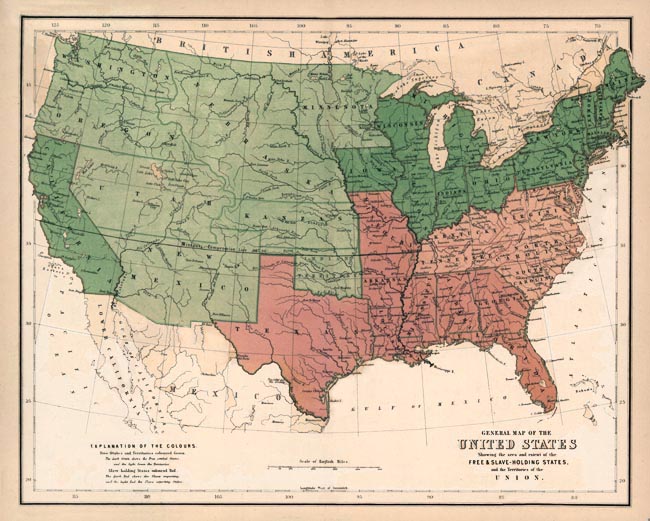
"Map of Free and Slave States."
The Slave Heritage Resource Center. 2008. Son of the South. http://www.bradley.edu/campusorg/psiphi/DS9/ep/503r.html.
Descriptions:
This is a map of the United States showing the free and slave states in 1857. The dark green states are the free states. The light green regions are the free territories - areas that are not yet states. The red states are the places where they import slaves. The pink states are the slave states that get their slaves from the red states.
Directions:
Directions:
The groups of dark green states are at the Northeast and there is one in the west. The light green regions are in the West center. The red states are in the Southeast and the pink states are in the east.
The dark green states were:
California, Iowa, Ohio, Wisconsin, Michigan, Pennsylvania, Maine, Vermont, Massachusetts, New Hampshire, Delaware, Rhode Island, New York, New Jersey, Maryland
The light green states were:
Washington, Oregon, New Mexico, Utah, Kansas, Nebraska, Minnesota, Oklahoma
The pink states were:
South Carolina, North Carolina, Tennessee, Kentucky, Virginia
The red states were:
Texas, Missouri, Arkansas, Mississippi, Florida, Georgia, Alabama, Louisiana
Conclusion:
California, Iowa, Ohio, Wisconsin, Michigan, Pennsylvania, Maine, Vermont, Massachusetts, New Hampshire, Delaware, Rhode Island, New York, New Jersey, Maryland
The light green states were:
Washington, Oregon, New Mexico, Utah, Kansas, Nebraska, Minnesota, Oklahoma
The pink states were:
South Carolina, North Carolina, Tennessee, Kentucky, Virginia
The red states were:
Texas, Missouri, Arkansas, Mississippi, Florida, Georgia, Alabama, Louisiana
Conclusion:
The Civil war certainly changed this map since the red and pink states don't have anymore blacks who are called slaves. I included this map to show how the United States looked before the Civil War ended and out and got rid of slavery. In this map you can see that the slave and the free states are adjacent to one another. This tells us that slavery really divided up the nation. Since the slave states are close to one another, they can easily work together and seperate from the nation.
Wednesday, May 21, 2008
Sharecroppers Wanted (revised)

David ,Carlton."History 276: The Old SouthSyllabus, Fall 2007." December 11, 2007.
<http://www.vanderbilt.edu/AnS/history/carltodl/276/hist276.htm>
SHARECROPPERS WANTED:
Do you want the security of having a job?
Do you miss living on a plantation?
Do you need a home for your family?
Are you about to starve to death?
Then check this ad out!
...
Job description:
Men's job: You need to work for ONLY 16 hours a day! All you have to do is pick ONLY 10 bags of cottons each day! You even get 10 minute breaks with cool water every 4 hours!
Women's job: You need to work for ONLY 16 hours a day!
All you have to do is make the house dust-and-bug-free! You will also get 10 minute breaks EVERY 4 hours!
Also, you will get a small but a comfortable house for you and your mate and get the best kind of food you've ever eaten!
...
Requirements:
If you are interested in this job, you must:
*Have a person you are seeing.
(a mate so that you could work together)
*Be an experienced former slave.
*Be strong and confident to do the job.
*Be a really positive person who doesn't complain.
...
Compensation:
Men and Women's Payment:
WOW!!!!
The couple receives the whole ONE FOURTH of the payment you make!
Hurry Up before someone takes this great opportunity!
If you meet the requirements and have an interest in having this wonderful job, please come to our plantation which is right next to the big peach tree.
Tuesday, May 20, 2008
Before and After (revised)
Before the Civil War:
Dear diary,
Today, I bought three slaves at the auction!
As soon as I came back from the auction with the slaves,
I set them to work on my wonderful plantation.
I think I chose the best ones since they didn't have any
scars and in addition to that, everyone looked really strong.
It was pretty expensive but it was worth it since now I don't
have to worry about their pay. They don't get paid and they
are all mine now... My properties....
One command does everything.
When I tell them to do this, they do this.
When I tell them to do that, they do that.
I set them to work, and then they make cottons,
then I sell the cottons and earn money!
I feel like I bought money with my money!
I'm very pleased with what I did today...!
As soon as I came back from the auction with the slaves,
I set them to work on my wonderful plantation.
I think I chose the best ones since they didn't have any
scars and in addition to that, everyone looked really strong.
It was pretty expensive but it was worth it since now I don't
have to worry about their pay. They don't get paid and they
are all mine now... My properties....
One command does everything.
When I tell them to do this, they do this.
When I tell them to do that, they do that.
I set them to work, and then they make cottons,
then I sell the cottons and earn money!
I feel like I bought money with my money!
I'm very pleased with what I did today...!
...
After the Civil War
Dear diary,
Arghh… Arggggggghhhhhhhh!!!
I'm so mad right now...
I can not control my feelings even though the South people are right.
I have no more slaves! No one to take care of my wonderful plantation!
I was once a man who was called a master and had the
abilities to treat the blacks like my very own property!
How can anyone live without slaves working for them???
Now I am the one who has to work in the cotton field
picking my own cottons out... This is really impossible!
I don't want to make my hand dirty and get blisters on my
hands like those other useless slaves!
My plantation is going to die now and I'll become poor.
I'd never ever think about MYSELF working on the plantation...
And I never will…!
I have to go have a rest for now...
I had too much... just too much...!
Reflection:
There are two diaries that is one about master's thoughts after and before the Civil War. The master was so glad about buying slaves and enjoyed using them without in need to pay them. In the diary about the master's thought after the civil war, the master is furious because now he doesn't have the rights to own the slaves. There was a new amendment saying that there should be no more slavery. I wrote it this way to show both thoughts in different situations. I also wrote this diary to show the master's thinking like I did with the slave's. The slaves' thought that it would be great to be free from the masters and live on their own but it wasn't really good after all since the Americans didn't give them any attentions. This tells me that the change wasn't such a good thing for both people after all.
Friday, May 16, 2008
Sushi Croptree (revised)
...

to mister croptree
Im your previos slave hoo you bit and gab me scars avery day i had done nathing rong but you will always choos me to whip when you ar in a bad mud. I want my child back You do nut desurve to have my buby gal now the government says so day sad that dare was a new amenment saying no mor slaves so you have to gib it up or you will burn in hell if you give them back to me suner the latur you will go to hell where you will burn untill you turn into ashes hedia will have to be in my arms befur the sun sets tomurow i will be waiting and waiting and hope you dont tuch my hedia not even frum the tip of your rotten fingors if you do tuch her then the part you tuched hedia with will burn until its nut dare anymor im nut going to threatun you wit anything els if you just bring my sueet baby hedia bak to me
from,
Sushi Croptree
Reflection:
This letter was from a girl named Sushi Croptree. She wants her daughter, Hedia back. This letter has a lot of misspellings and it tells you that Sushi didn't get full education. She saw her masters writing and teachers teaching the masters' kids. She heard them but couldn't see them. So she basically wrote what she heard and knows what each letter sounds like.
Thursday, May 15, 2008
Reconstruction 1863-1877
1865 Jan.: Thirteenth Amendment was approved.
1865 Dec.: Thirteenth Amendment was ratified.
1865 Apr.: The Civil War ended.
................. : Vice President, Andrew Jackson becomes the president after Abraham Lincoln's Assassination.
.
1867: First Reconstruction Act passed.
...........Second Reconstruction Act passed.
...........Third Reconstruction Act passed.
.
1868: Fourth Reconstruction Act passed.
........... Fourteenth Amendment was ratified: 'Entitles all persons born or naturalized in the United States to citizenship and equal protection under the laws of the United States.'
.
1870: Hiram Revels became the first black senator.
........ : Joseph H. Rainey became the first black member of U.S House of Representative.
.
1871: There was an act to enforce the fourteenth Amendment also known as Ku Klux Klan Act.
.
1874: Robert Smalls was the hero of the civil war and he was elected to Congress as representative of South Carolina.
.
1875: Congress enacted the Civil Rights Act: An act to provide black with the right to equal treatment in public places and transportation.
1865 Dec.: Thirteenth Amendment was ratified.
1865 Apr.: The Civil War ended.
................. : Vice President, Andrew Jackson becomes the president after Abraham Lincoln's Assassination.
.
1867: First Reconstruction Act passed.
...........Second Reconstruction Act passed.
...........Third Reconstruction Act passed.
.
1868: Fourth Reconstruction Act passed.
........... Fourteenth Amendment was ratified: 'Entitles all persons born or naturalized in the United States to citizenship and equal protection under the laws of the United States.'
.
1870: Hiram Revels became the first black senator.
........ : Joseph H. Rainey became the first black member of U.S House of Representative.
.
1871: There was an act to enforce the fourteenth Amendment also known as Ku Klux Klan Act.
.
1874: Robert Smalls was the hero of the civil war and he was elected to Congress as representative of South Carolina.
.
1875: Congress enacted the Civil Rights Act: An act to provide black with the right to equal treatment in public places and transportation.
Uncle Sam and the Slaves

Abraham Lincoln (revised)
 Name: Abraham Lincoln
Birthdate: Feb. 12, 1809
Birth Place: Hardin County
Nickname: Honest Abe
Marriage: Nov, 4, 1842
Wife: Mary Todd
Children: Robert Todd Lincoln
Edward Baker Lincoln
William Wallace Lincoln
Thomas "Tad" Lincoln
.....................................................
Overview of his life:
Overview of his life: Abraham Lincoln was born in the year of 1809, in Kentucky. He had a mother, father, sister named Sarah and a brother named Thomas who died in infancy. His family moved to the southern Indiana when he was seven years old. Lincoln's mom died of milk sickness in 1818. Year after the death of his mother, his father remarried a woman named Sarah Bush Johnston Lincoln and Lincoln liked his new stepmother.
...
As he grew up, he loved to read and preferred learning to working in the field. So he went to school for a short period of time in Indiana as he had done in Kentucky. His interests in learning made his relationship to his father and his relationships hard because his father didn't want Lincoln to focus on school. Unfortunately, in the year of 1828, his sister, Sarah died during childbirth. In the late 1828, he went to New Orleans. In 1830, he moved to Illinois. The next year Lincoln made another trip to New Orleans. After that, he moved to New Salem, Illinois where he stayed until 1837.
...
In Illinois, he had several jobs which were: operating a store, surveying, and serving as postmaster. He also impressed the residents with his character, and got his nickname which was Honest Abe because he would beat the village's bully. Lincoln was about 6 to 4 feet and weighed about 180 pounds. After he saw the Black Hawk War briefly, he made an unsuccessful run for the legislature in the year of 1832. He ran again in the years of 1834, 1836, 1938 and 1840 with successful results. Abraham Lincoln also studied laws in his spare time and became a lawyer in 1836. There was a story that he had a romance with a girl named Ann Rutlege which might have been true, but she died in 1835.
...
In the year of 1839, Lincoln met Mary Todd. Fourteen years later, they were married and had three children (above). After, Lincoln became a successful Attorney and in 1844, the family moved to a house at the corner of Eighth and Jackson in 1844. In 1846, he ran for the United States House of Representatives and won. While he was in Washington, he was known for his opposition to the slavery. He resumed his law practice more seriously after his term was over. Early in 1851, Lincoln's father died. In 1856, he gave his lost speech. He opposed the Dred Scott decision in 1857 and gave another speech name House Divided speech in the year of 1858. In 1858, Lincoln wasn't a abolitionist but he was against the spread of slavery to territories.
...
After the fall of Ft.Sumter, Lincoln made an army and decided to fight to save the union from falling apart. On January, 1, 1863, the Emancipation Proclamation showed some affects. This was Lincoln's declaration of freedom to all the slaves. On November, 19, Lincoln gave another speech, Gettysburg Address which was dedicated battlefield to the soldiers who had perished. Lincoln's policies contained the support for the Homestead Act. This act allowed the poor people from the east to obtain lands in the West.
...
In 1864, South was slowly losing strength. Lincoln was reelected president with Andrew Johnson as his running mate. Lincoln won over the Democrat George McClellan on November, 8 in the year of 1854. On April, 9, 1865, General Robert E. Lee surrendered to grant. Two days later, Lincoln addressed to the crowd outside the White House. He also suggested he would support voting rights for some blacks. This made racist and Southern sympathizer who was in the audience furious. His name was John Wilkes Booth who hated everything Lincoln stood for.
...
On Good Friday, April, 14, 1865 President Lincoln got shot in the head and died. He had attended a play titled Our American Cousin at Ford's Theatre. During the play, Booth arrived at the play and he shot him. Lincoln was carried across the street to the Peterson House where he passed away next morning. This was the first presidential assassination in the American History, and the nation mourned its leader. His death was the cause of the hatreds of the times. Lincoln's body was taken to the Springfield by train and was buried in the Lincoln Tomb in Oak Ridge Cemetery on May 4th, 1865. Because of this event, the Reconstruction had to take place without the President Lincoln's leadership. Lincoln was a brave man who fought on the side of the slaves and wanted it to end.
Citation for the Image:
Kurt, Mosser. "Course Description and Goals."
American Political Theory: Foundations, Theory, and Practice.
<http://academic.udayton.edu/KurtMosser/Nanjing.html>.
Sharecroppers
 Sharecroppers are former slaves who grow crops on the land the owner had provided for them. The owners also provided shelter for the farmer and his family, farming equipments and his labor. This might seem pretty fair but when it comes to their wages and payments, people's thoughts would change. The farmers had to give the owners the three fourth of their wages. This is not the end; slaves also had to pay back on the credit for the living expenses. Sometimes the money the farmers had to pay would be higher than the amount they earned so they had to work more to pay back. You work, earn money but it's not enough so to pay that back, you have to work again. This will repeat and the farmers usually don't earn anything from working
. . . . .
This concludes that sharecropping isn't fair after all. The slaves had to keep on working for the owners in order to pay them back and as they work, their living expenses will grow and grow and end up owing more than before.Citation for the picture:
"Slave to Sharecropper." Reconstruction The Second Civil War. 2004. PBS Online.
Wednesday, May 14, 2008
Q&A (revised)
 "Let us Welcome the United States National Slavery Museum."
 Searching For Truth. August 17, 2006.
1. What is freedom from slavery called?Scrambled word hint: neomiatnacpi
2. Slavery is the main cause of this war.
Scrambled word hint: lciivrwa
3. The abolitionists helped the slaves to get this.
Scrambled word hint: mfordee
4. What is the time period after the civil war called? The Americans were rebuilding thier country at this time
Scrambled word hint: nroeictocnutrs
5. The slaves had a hard time working on this.
Scrambled word hint: npoloattani
6. The 13th _________ stated that there shall be no more slavery.
Scrambled word hint: tanmeemnd
7. What is the name of a man whose words brought the new birth to freedom to America?
Scrambled word hint: ambrha nllionc
Answers Below...
.
.
.
.
.
.
.
.
.
.
.
.
.
.
.
.
.
.
.
.
.
.
.
.
1. Emancipation
2. Civil War
3. Freedom
4. Reconstruction
5. Plantation
6. Amendment
7. Abraham Lincoln
Free at Last? (revised)
"Fundraising Is Way Down For Slavery Museum ."
News You Should Know. December 3, 2007 . Bet.com.
<http://blogs.bet.com/news/newsyoushouldknow/?m=20071203>.
Free at Last?

Free at last!
We won the war,
Got the rights
Freedom is like a
big sweet birthday cake
But something is missing
on the birthday cake,
Something BIG.
.
.
Free at last.
Free at last.
But what does it mean to be free?
My clothes are rough and wrinkled,
turned into a brownish rag
My back it's a mud covered pig pen,
sweats tickling down the back
.
.
Free at last?
Free at last?
No family,
No friends,
No food,
No friendly faces,
No fence around my house
Is this really freedom?
.
.
Reflection: Reflection: This poem is about slaves who just got their freedom but doesn't feel like it's a freedom. They don't get attentions from the Americans. This whole poem is basically a narrative since it tells about slaves who just won the civil won and got their freedom. Even though this poem is a narrative, I have similes, metaphors, symbolism and imagery in it. I tried to put in all types of poems because I didn't know which I should choose. In the first stanza, it contains a simile and symbol. 'Freedom is like a birthday cake'. This is a simile representing that freedom is really sweet and big. It's a simile since it uses like or as to compare the cake and the freedom. 'But something is missing on the birthday cake'. The cake is representing freedom and something is missing on it. This is a symbolism because the cake symbolizes freedom. In the second stanza, there is imagery and a metaphor. The stanza is showing the slave's appearance: their clothes and their sweaty back. 'My back it's a mud covered pig pen'. This is a metaphor because it compares the slave's back and the muddy pig pen. It means that the slave's back is really dirty. The last stanza, I liked the best. It had alliteration. Alliteration is the repetition of the first letter of the first word. Family, friends, food, fence, friendly faces and freedom all has a F for their first letter. This poem was pretty easy to write about and I think I did a good job of improving my poem using the advice from Ms.Sackstein.
...
Simile is a poem that contains a comparison between two objects using the words like or as. Metaphor is a poem that contains the comparison between two objects with out using the word like or as. Symbolism is a poem that contains an object and it symbolizes something. Imagery is a poem that contains descriptions which gives the readers vivid images.
...
Simile is a poem that contains a comparison between two objects using the words like or as. Metaphor is a poem that contains the comparison between two objects with out using the word like or as. Symbolism is a poem that contains an object and it symbolizes something. Imagery is a poem that contains descriptions which gives the readers vivid images.
Tuesday, May 13, 2008
Game: Scramble
Scramble
1. lveass
2.ipeamctinnao
3. vcili rwa
4. edrfoem
5. nroeictocnustrt
6. haers poecpr
7. nemtemda
8. lpttonaain
9. yetqiula
10. ncoointsutti
Answers:
1. Slaves
2. Emancipation
3. Civil War
4. Freedom
5. Reconstruction
6. Share Cropper
7. Amendment
8. Plantation
9. Equality
10. Constitution
Poem: Free at Last?
Free at Last?
Free at last!
We won the war,
Got the rights
But something is missing,
Something BIG
Free at last.
But what does it mean to be free?
No respect,
No families
This is not freedom!
Free at last?
No money,
No job...
No money,
No job...
Is this really freedom?
Subscribe to:
Comments (Atom)